
Yubo Wang

I completed my undergraduate degree in Mathematics at New York University (NYU). I am currently a research intern at the Shanghai Academy of AI for Science (SAIS), working on JEPA world models for efficient and long-horizon planning.

My interests lie in self-supervised visual representation learning and how learned representations transfer to downstream tasks. I am particularly interested in JEPA world models.

Email/CV/GitHub

Yubo Wang at New York University

Selected Research Projects

Efficient and Long-Horizon Planning with JEPA World Models

Studying and reproducing JEPA world models, from visual representations and latent dynamics to planning. I am investigating computational bottlenecks in MPC, exploring more efficient planning algorithms, and studying hierarchical models for prediction and planning at multiple temporal scales.
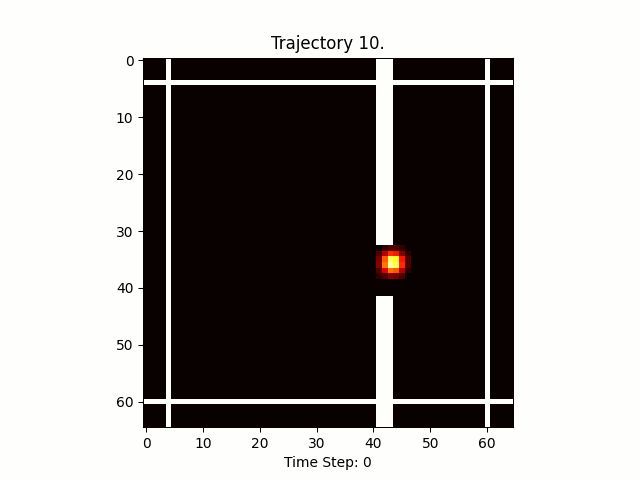
Two-room environment with a wall and doorway from my JEPA course presentation.

Building a Task-Specific JEPA World Model

Built a 3.63M-parameter, action-conditioned JEPA model on 2.5M offline trajectories in a two-room environment. Used Barlow Twins warmup, MSE alignment, and encoder freezing to prevent collapse, and evaluated generalization to new layouts and longer rollouts.

Ranked second overall and achieved the best model performance in the course competition.

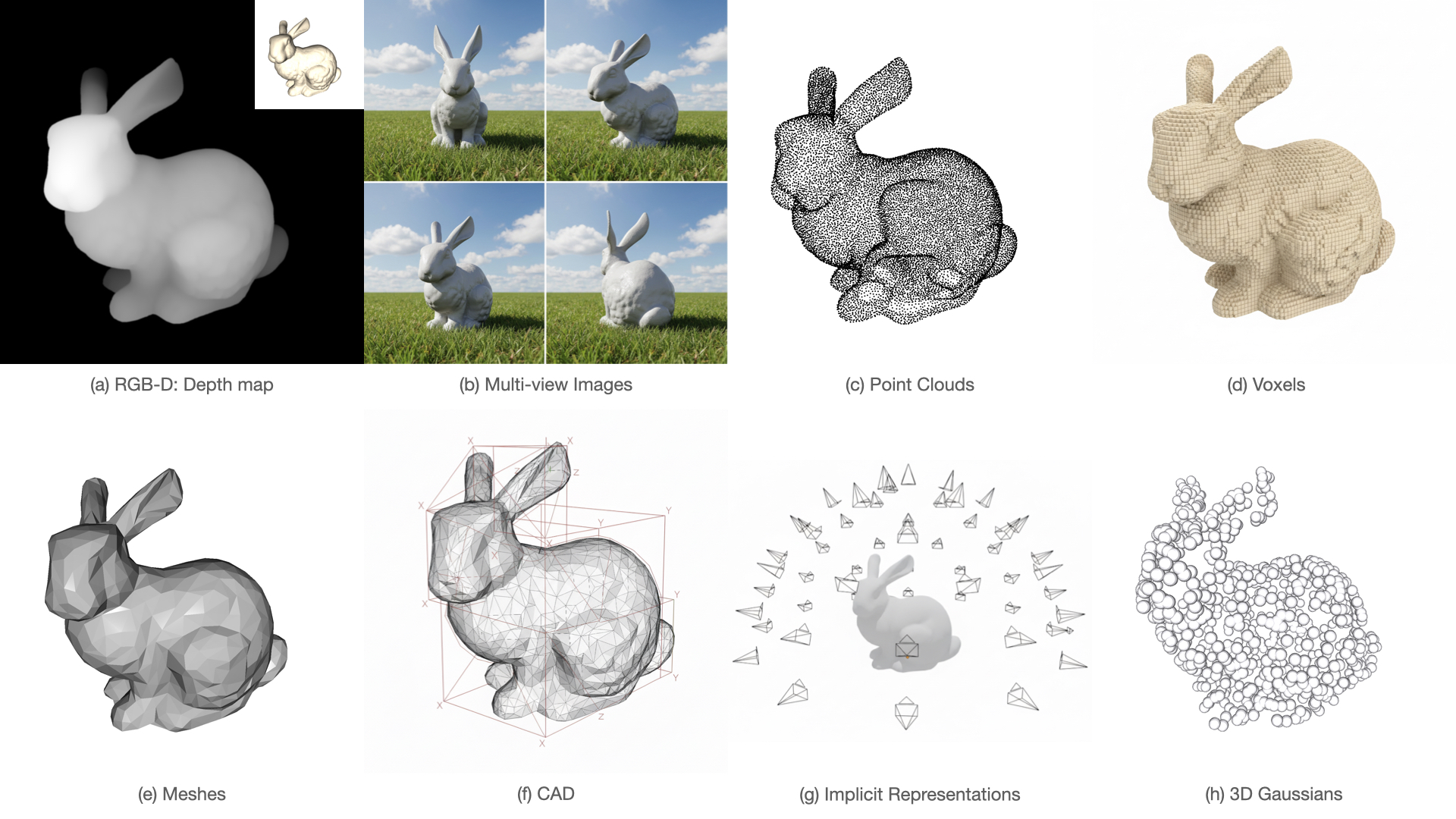
Eight ways to represent 3D geometry, illustrated with the Stanford bunny.

A Cookbook of 3D Vision: Data, Learning Paradigms, and Application

Hongyang Du, Zongxia Li, Dawei Liu, Runhao Li, Haoyuan Song, Qingyu Zhang, Yubo Wang, Jingcheng Ni, Shihang Gui, Congchao Dong, Tao Hu

CVPR OpenSUN3D Workshop, 2026

Co-authored a data-centric survey of 3D representations, datasets, and learning paradigms across reconstruction, generation, and embodied intelligence. Analyzed 50 representative datasets and co-maintain the companion repository, with a focus on world models.

Information Theory for Statistics and Machine Learning

Presented Leung and Barron’s Information Theory and Mixing Least-Squares Regressions (2006) and derived the key oracle inequality for exponential-weight model averaging. Coursework covered information-theoretic tools for minimax risk, sample complexity, and statistical estimation.

Randomized Algorithms and Monte Carlo Methods

Presented Fearnhead et al.’s Piecewise Deterministic Markov Processes for Continuous-Time Monte Carlo (2018), worked through generator and invariance derivations, and implemented a Zig–Zag sampler with event-time thinning on a 2D Gaussian target.